Systems
Velis
A Python cache and pub/sub server with expiring byte values, bounded queues, and a terminal workspace for exploring a running store.
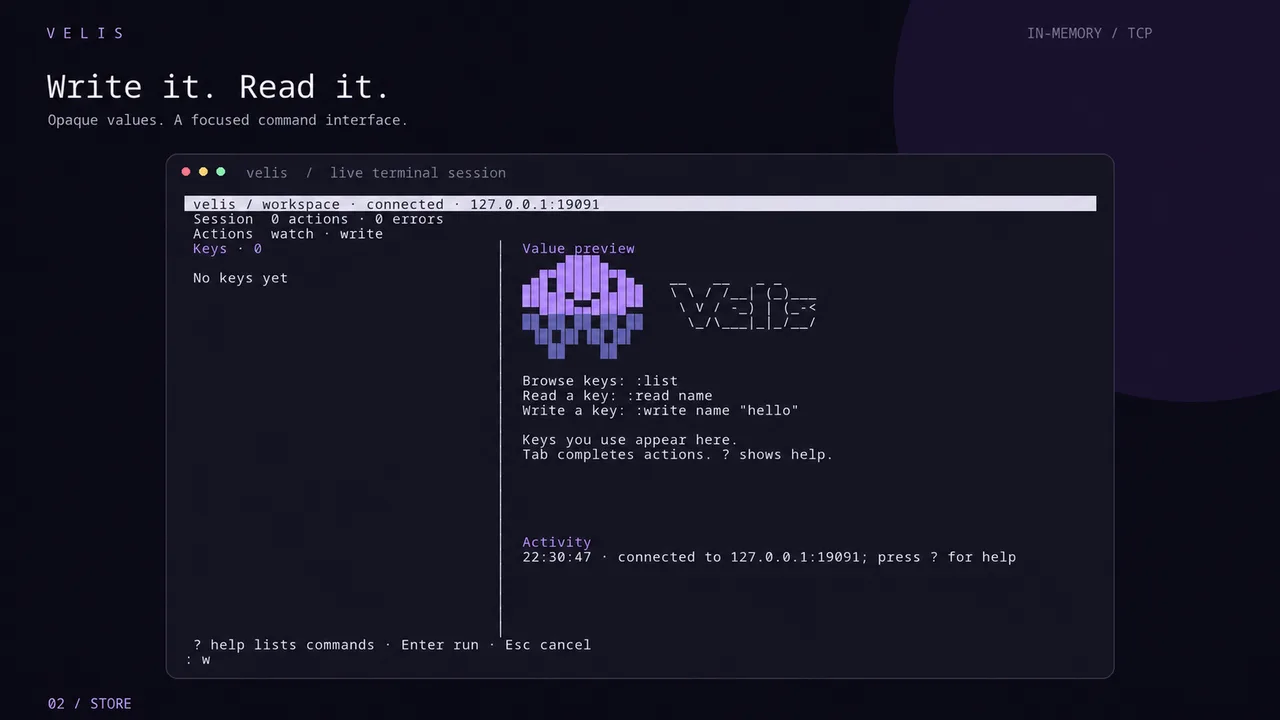
A cache you can explore
Velis brings together an in-memory store, channel subscriptions, a TCP server, an asynchronous Python client, and an interactive terminal. You can give a value a lifetime, watch it expire, or send a message to connected subscribers.
The terminal keeps keys, value previews, and recent activity in separate panes. It supports key discovery, local filtering, command completion, read-only sessions, and statistics for the current session. Selecting a key leaves the server untouched until you explicitly read it.
Keeping work bounded
A single asyncio event loop owns the store and subscription broker. Core operations run synchronously, while connections handle I/O and flow control. Memory mutations happen on one thread.
- Expiration: monotonic deadlines keep lifetimes independent of wall-clock changes. Reads discard expired values, and background sweeps reclaim them in bounded batches.
- Capacity: key and byte budgets work with interchangeable S3-FIFO, LRU, and LFU eviction policies.
- Slow consumers: bounded pending requests and message buffers keep one connection from accumulating unlimited work.
Architecture
The network layer turns binary frames into typed commands. The engine dispatches them to a core that can be tested without sockets or real-time waits.
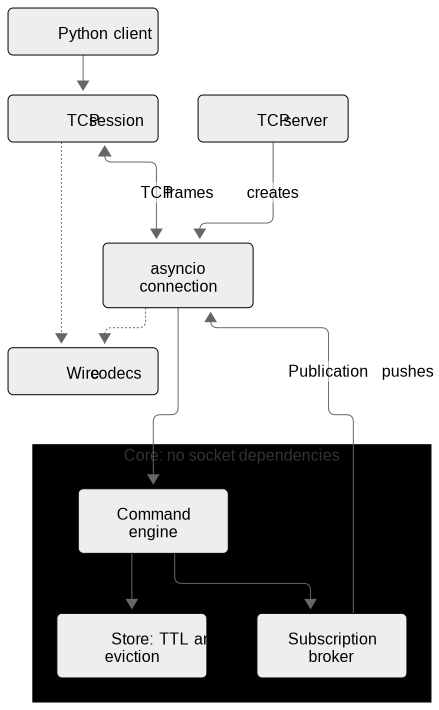
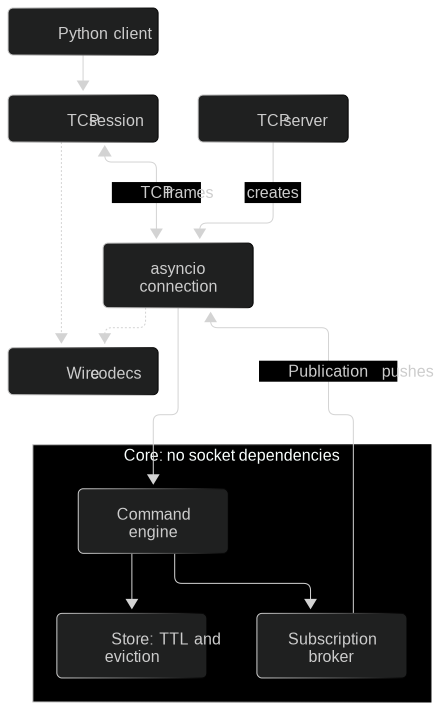
See the architecture and ownership boundaries.
Working with the client
After starting the server with uv run velis, a client can write a value and give it a five-second lifetime:
import asyncio

from velis.net.client import Client

async def example():
    async with await Client.connect("127.0.0.1", 9000) as client:
        await client.write("greeting", b"hello")
        await client.lifetime("greeting", 5_000)
        print(await client.read("greeting"))

asyncio.run(example())
Running and checking it
The setup guide requires Python 3.15.2 or newer. Run uv sync in the checkout, start the server with uv run velis, and open the terminal workspace separately with uv run python -m velis.tui. The application has no runtime package dependencies.
Tests use unittest and Hypothesis, including generated cache-operation sequences checked against an independent LRU model. Coverage includes eviction policies, expiry, protocol handling, client lifecycle, TCP integration, and terminal behavior. Ruff, ty, and Pyright provide additional static checks; the development section lists the commands.
What batching changes
The repository's November 10, 2026 localhost run used one connection, 64-byte values, and three measured repeats. Median throughput through Client.batch() changed substantially when the submitted depth increased:
| Operation | Depth 1 | Depth 64 |
|---|---|---|
| Write an existing key | 16,085 ops/s | 123,681 ops/s |
| Read an existing key | 17,025 ops/s | 144,491 ops/s |
Those measurements used CPython 3.15.2 on a Ryzen 5 7535HS. They show the effect of amortizing request overhead in that setup; they do not measure production tail latency or subscriber fan-out. The benchmark section includes sample ranges and reproduction commands.
Tradeoffs
Values and deadlines live in process memory. Pub/sub delivers to connected subscribers at most once. Batches preserve reply order but are not transactions, and cancelling a sent request does not undo its server-side effects. Authentication and TLS are outside the current implementation.