Backend
Gym CRM
A Java backend for gym members, trainers, and training sessions, with JWT authentication and monthly workload tracking through Kafka and MongoDB.
From training sessions to monthly workload
Gym CRM began during my EPAM Java Lab internship. I later modernized it as a portfolio project, adding a reproducible multi-module build, documented REST APIs, and database and messaging integration tests.
Members and trainers can register, manage profiles, and maintain assignments. Trainers schedule and cancel sessions; participants can retrieve their sessions and search by date, training type, or participant with bounded pagination. Swagger UI provides an interactive entry point to the API.
Two services, two data models
The CRM API stores accounts, assignments, and sessions in PostgreSQL, with Flyway migrations managing the schema. After a session transaction commits, it publishes a workload event to Kafka. A separate service consumes those events and maintains monthly trainer totals in MongoDB.
Events use the trainer username as their Kafka key to preserve per-trainer partition ordering. Transient processing failures are retried, while exhausted or business-invalid events go to a dead-letter topic for inspection and replay. MongoDB optimistic locking protects concurrent workload updates.
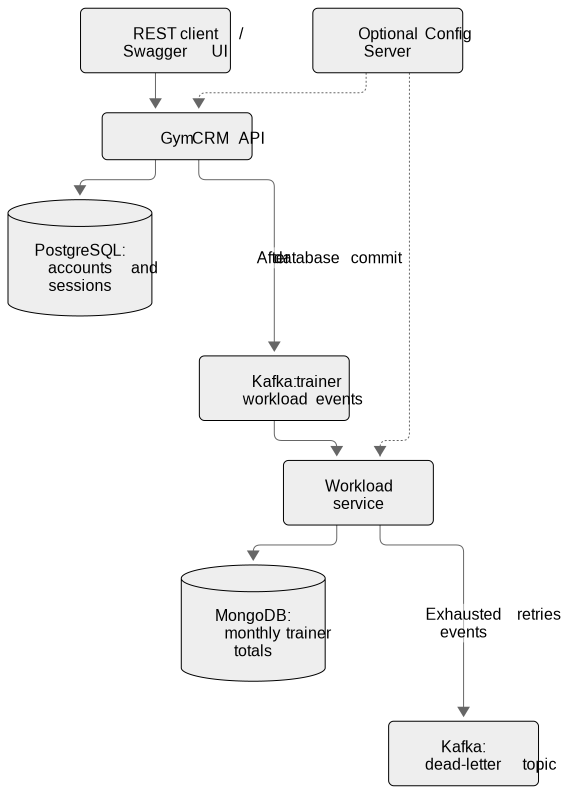
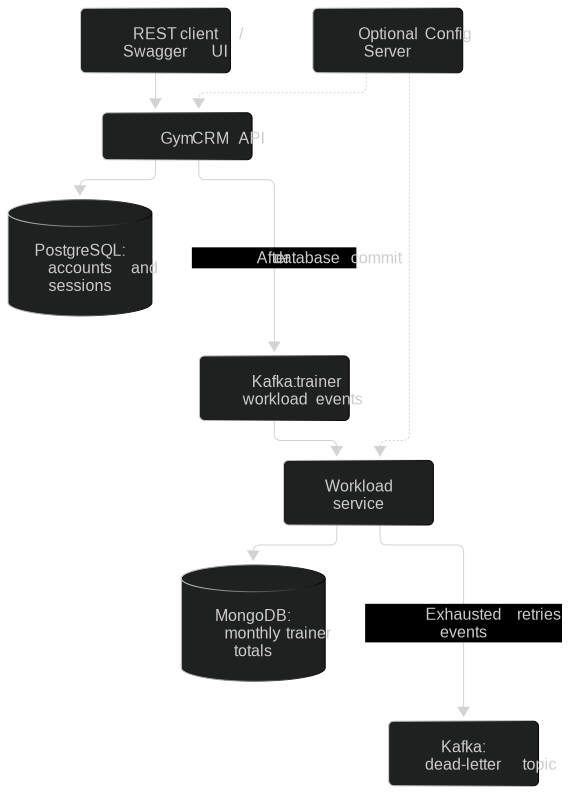
The architecture documentation explains the service boundaries and design decisions.
Authentication and API behavior
RSA-signed JWTs authenticate requests, and BCrypt protects stored passwords. The training API checks participant ownership: only the assigned trainer can create or cancel a session, and only its trainer or trainee can retrieve it. Validation failures use structured problem details, while transaction IDs connect HTTP requests to logs and workload events.
Running and verifying the system
The project provides REST services rather than a browser frontend. It requires JDK 25. The standalone API uses an in-memory H2 database for a quick local demonstration; its data resets on shutdown and workload publishing is disabled. Docker Compose runs the full PostgreSQL, MongoDB, and Kafka stack. The Maven reactor builds the API, workload service, shared contracts, and optional configuration server together.
Tests exercise the HTTP workflow with real JWTs, PostgreSQL migrations and queries, and Kafka-to-MongoDB workload processing. Testcontainers supplies infrastructure for integration tests, and Cucumber covers application workflows.
See the README for startup commands and API examples.
Delivery tradeoffs
Publishing after the database commit leaves a failure window between persistence and messaging. A transactional outbox and idempotent consumers remain follow-up work: redelivery can currently double-count workload events. Dead-letter recovery currently handles decoded events; malformed JSON still needs a deserialization recovery policy. Legacy profile and workload endpoints also need a more complete authorization model, and issued JWTs remain valid until expiry after password changes or account deactivation.
The project models date-based sessions; timeslot conflicts, attendance, memberships, and billing are outside its current scope.