Web apps
Beauty Code
A live Georgian storefront that connects product discovery to shop conversations, with catalog administration, full-text search, and image delivery.

From a product to a conversation
Beauty Code serves two audiences: customers browsing a Georgian product catalog, and the shop owner keeping that catalog current. Visitors can search products, compare current and discounted prices, explore galleries, and ask the shop about a specific item.
Product chat actions pass the item's name, price, and page URL into Crisp, giving the conversation context. General contact actions open a conversation with the shop. The catalog is built around browsing products and starting a conversation.
My role
I serve as Beauty Code's CTO and technical lead. I handle the store's technical work: building and maintaining the storefront, catalog tools, image delivery, and deployment, and solving technical problems as they come up.
Online store with about GEL 10,000 in monthly revenue and 25,000+ social media followers.
Keeping the catalog consistent
The admin interface manages products, categories, availability, and ordered image galleries. Publishing state and stock state are separate: drafts stay private, preorders remain visible, and an out-of-stock item keeps its page while its order action is disabled.
A product save updates its fields, gallery references, and audit record in one SQLite transaction. Full-text search indexes follow database changes through triggers. Renaming a product preserves its existing slug, so links continue to work.
Architecture
React and TanStack Start provide the pages and server endpoints. Public catalog reads and authenticated writes share SQLite; image uploads and database snapshots have dedicated services.
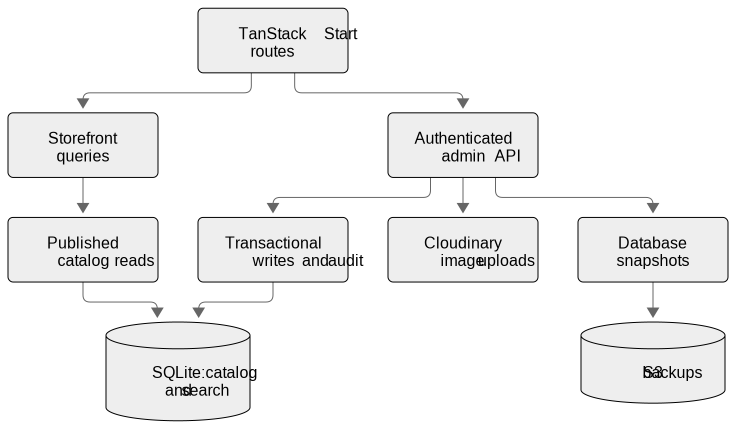
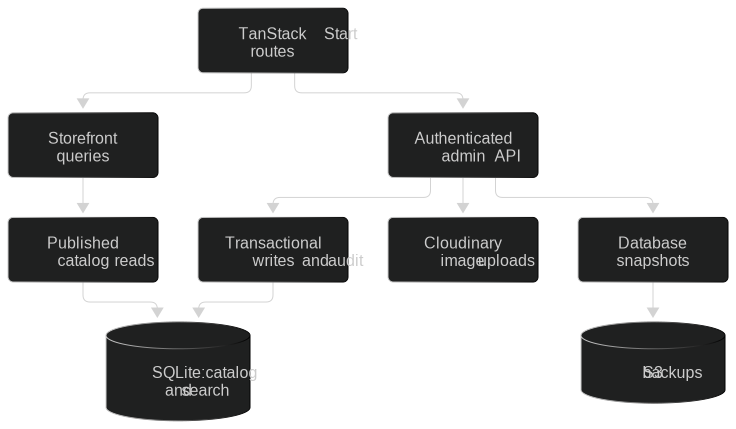
The application documentation explains these boundaries and the catalog's visibility rules.
Responsiveness and measurement
Catalog navigation reuses TanStack Query data and intent preloads, with category metadata and products loading in parallel. Admin updates invalidate both public and admin queries. Deferred search keeps typing responsive, while React Activity boundaries preserve editor drafts across admin tabs.
Georgian fonts are self-hosted and preloaded. Crisp loads asynchronously, and product images use responsive delivery. These are implementation choices rather than a guarantee of a particular performance score. The storefront documentation distinguishes production measurements from development behavior; conversion tracking still needs an analytics destination and completed-order integration.
Images and recovery
Uploads are checked for file size and signature before the original goes to Cloudinary. Product cards and galleries request responsive image sizes with automatic format and quality selection.
Database snapshots preserve the catalog, search data, galleries, and audit history. Restore checks integrity, foreign keys, and schema compatibility, then keeps a safety copy before replacing an existing database. Cloudinary image assets have a separate lifecycle: a database snapshot preserves their URLs, not the image files.
Operating the storefront
The deployment uses Docker Compose and nginx on one EC2 host. Terraform defines the network, instance, role, Elastic IP, and S3 backup bucket. nginx handles HTTPS and admin authentication, while the application stays on the private container network.
This keeps the operational model small, with a clear recovery tradeoff: replacing the host requires restoring the catalog, and the setup has no automatic failover. The deployment and recovery guide covers releases, backups, and restoration. Tests cover catalog behavior, authorization, search, backups, and SEO.